

After dusting off our cowboy hats, boots, and shotguns (haha), we headed East finally to New Mexico. We spent a good six hours traveling I 10, a most familiar interstate for our family. It will eventually lead us all the way back home to our family in Jacksonville, but not until we finish a few more parks and must-sees along the way. Two more weeks of traveling and then it’s back to the grind of retirement life in Naples.
We arrived in Alamogordo, NM, home to two of the most fascinating places on Earth. The White Sands National Park and the White Sands Missile Range. If you are up on your national park information, this is the 62nd out of a total of 63 National Parks, having been designated as such in 2019.
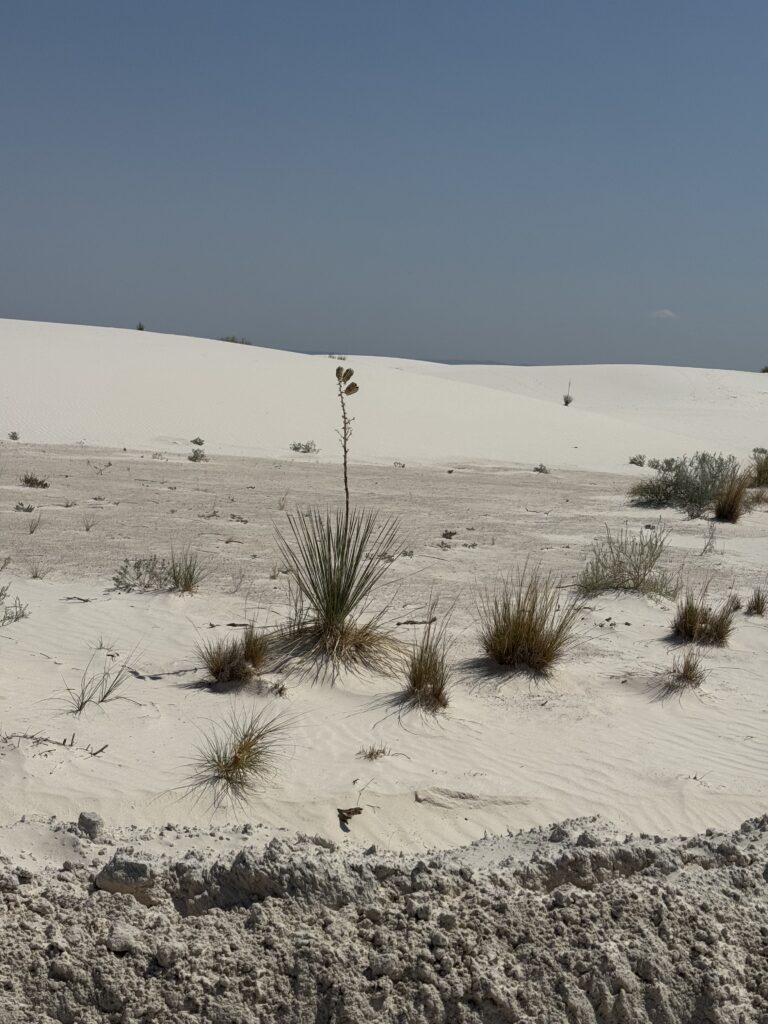
The White Sands Missile Range may sound familiar to you, if you are up on your WWII history, or you saw the movie Oppenheimer. Both these locations have a special place in our American history for two distinct reasons.
First, White Sands National Monument was designated in 1933 by President Hoover. The unique structure of the sand and the sheer size of the dunes is the rarest and largest on Earth. The sand is not regular quartz sand (beach sand from the ocean). These dunes are made from rare gypsum crystals. More than 250 million years ago, a giant, ancient sea left behind thick gypsum deposits. As the tectonic plates shifted throughout this area, ice-age rains washed the gypsum into a trapped lake. As the Earth heated, the lake waters dried up, leaving the gypsum exposed. Strong desert winds pulverized the gypsum crystals into fine white sand.
Today, these serene and spectacular dunes continue to shift and change due to continued strong desert winds. This is the largest deposit of gypsum crystal sand in the world, stretching over 275 square miles. The pictures don’t do the scene justice. It’s other worldly to stand atop of 30-foot white sand dune in the middle of a desert and feel the cool, soft, glistening sand underneath your feet.
Second, The White Sands Missile Range covers more than 3,000 square miles and has been used for testing our military’s missiles and rockets since the 1940’s. It is considered the “Birthplace of America’s Missile and Space programs”. Even more fascinating, it is where the world’s first atomic bomb was tested at the Trinity Site, July 16, 1945.
This site supports our Army, Navy, Air Force and Space programs. Holloman Air Force Base is located here, covering almost 60,000 square acres, and primarily acts as a premier training facility for aerospace activity.
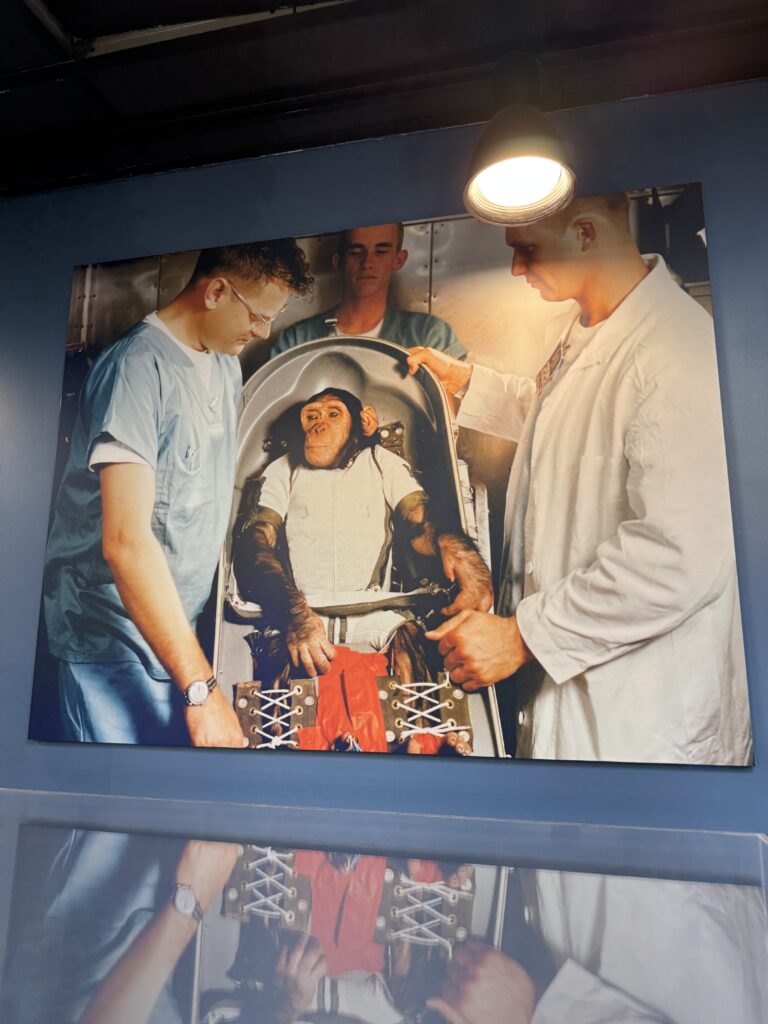
The New Mexico Museum of Space Museum is a state of the art, five story complex which pays homage to all the men and women involved in advancing our country’s space, flight, and missile projects. The coolest exhibit for me was the burial site of HAM the space monkey. I learned so much more info on him – even his tiny little space suit is on display.
We didn’t travel to the Trinity site which is only open to the public on certain dates and times. This is the exact spot where the first atomic bomb was dropped and tested. Today, a giant obelisk stands to commemorate the solemn occasion. Fascinating to me was that the rocks which survived the initial thermal blast have now turned into a unique glass-like, green hue of mixed feldspar, silica quartz, and clay, mixed with traces of the metal test tower and the bomb materials, all fused together from the intense atomic blast. These new formed rocks are referred to as Trinitite (or atomsite or even Alamogordo glass). Collecting of this rock is illegal. And yes, it remains slightly radioactive. Luckily, there are plenty on display at the museum and Visitor Center.
Our last evening there, we ventured to the dunes at sunset to watch what was described as a spectacular colorful display of the sun casting purple and pink shadows on the white dunes and across the sky. It was a perfect, romantic evening, and the sunset show did not disappoint. There were so many people scattered across the dunes, like tiny ants, all facing west, waiting for those brilliant colors to appear. There were young kids sledding down the sandy dunes, we saw a couple get engaged, we heard several folks speaking in foreign accents, and we witnessed a very memorable sunset.
I highly recommend, if you are in this part of the country, to come visit this unique place. It has few trees or wildlife, it’s hot and out of the way, the town is a bit rough around the edges, but it offers a peak into our past. The destructive nature of man and nature converge – atomic bombs and missiles and white gypsum sand ground down to fine crystals. Peaceful and violent acts – which is more destructive, I wonder, man or nature?