

Who knew that subterranean caves and oil fields had so much in common? I sure didn’t. I also didn’t realize that Carlsbad, New Mexico was geographically part of the Permian Basin, which, if you don’t watch Landman and don’t know, is the massive sedimentary basin and highest producing oil field in the USA. It is primarily in West Texas near Midland and Odessa but also crosses over into SE New Mexico.
We left Alamogordo and headed East up over the mountain passage. We ventured through remote ski towns like Cloudcroft, then drove down the mountain and ended up back in the desert landscape with miles upon miles of absolutely nothing around us except for cactus plants, tumbleweed, and sad, run-down outposts of double-wide campers and adobe and wooden shacks. We have seen so many abandoned towns and closed-up storefronts and places that seemed destined to be forgotten. As we inched closer to Carlsbad, we disbelievingly stumbled upon hundreds of oil rigs and pumping stations and realized we were in oil country.
After looking up on our phones, we came to learn about that stretch of the Permian Basin and that Carlsbad is a significant producer of oil and natural gas. This knowledge was reinforced when we drove to our campsite for the next to two nights. It was an RV park, but not like one we had been at before.
We realized that any RV park in this neck of the woods is basically a parking lot with full hook-ups for all the roughnecks and landmen. Better known as worker camps. I think we were the only “family”. I must admit, however, it was quiet and convenient to town and the caves. The place just had no charm, no amenities, no anything except for RV’s and trucks! It is perhaps better than a Walmart parking lot, which isn’t saying much, and I can share that from experience.
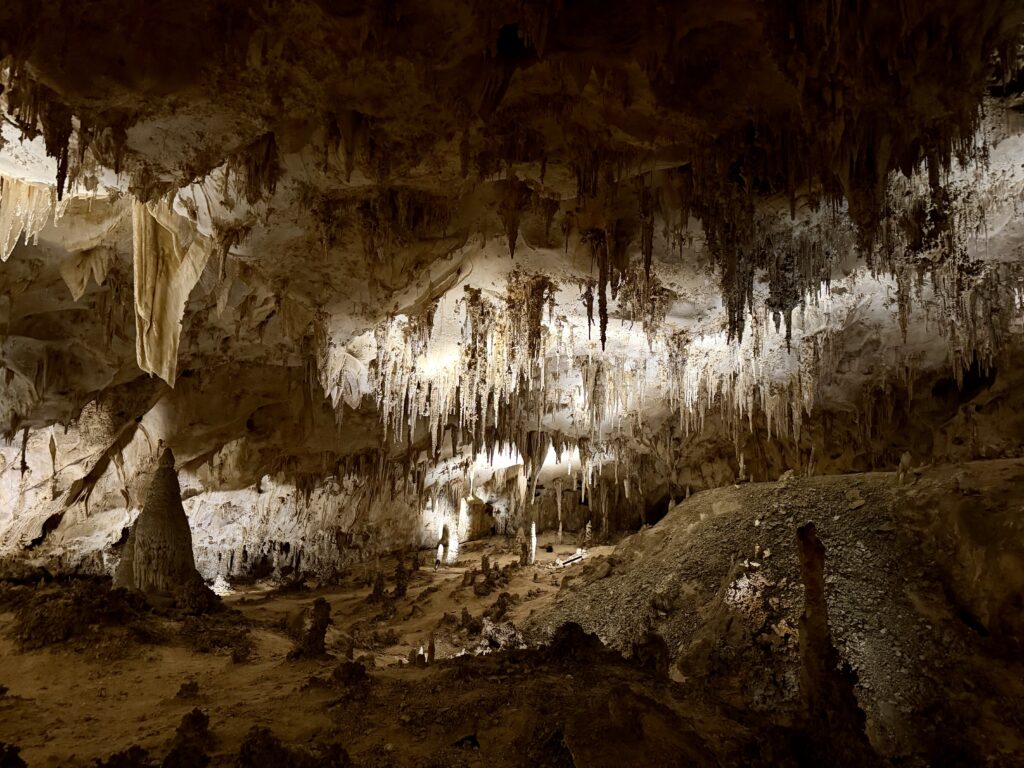
What we really came here for was to see the famous caverns and I sure am glad we did. The history, the beauty, the other-worldly cave formations of stalactites and stalagmites was truly remarkable.
The caverns history goes back 250 million years ago when the Capitan Reef formed from an ancient sea and its fossilized aquatic life (seashells and algae). When the sea warmed and dried up, hydrogen sulfide gasses rose from the hidden oil deposits, and mixed with the ground water to create sulfuric acid. When that dissolved the remaining limestone, huge caverns formed from the ground up, compared to other caverns which formed top down due to flowing water and erosion. Over time, trickling down water deposited calcite which created the stalagmites and stalactites now seen.
The ancient caves had many uses, homes for the first natives some 20,000 to 10,000 years ago, shelter for ice-aged mammals, home to the Mescalero and Apache communities, bat guano mining in the 19th to early twentieth century, and finally, as a protected World heritage site and now a National Park.
Carlsbad Caverns has many chambers, but the largest chamber, the most voluminous in North America, aptly named The Big Room, is as high as 255 feet and 4,000 feet in length. That’s big enough for six football fields across or almost high enough to fit the Statue of Liberty. From the Visitor Center down to the chamber floor, is a whopping 750 feet – we took the elevator up and down as opposed to trekking up and down. We are adventurous, not crazy!
In comparison, Mammoth Cave in Kentucky, is a multi-level maze consisting of hundreds of intersecting tube-like passages with some reaching a ground depth of about 380 feet. There are over 426 miles of passages which are currently mapped, which designates Mammoth Cave as the longest cave system in the world!
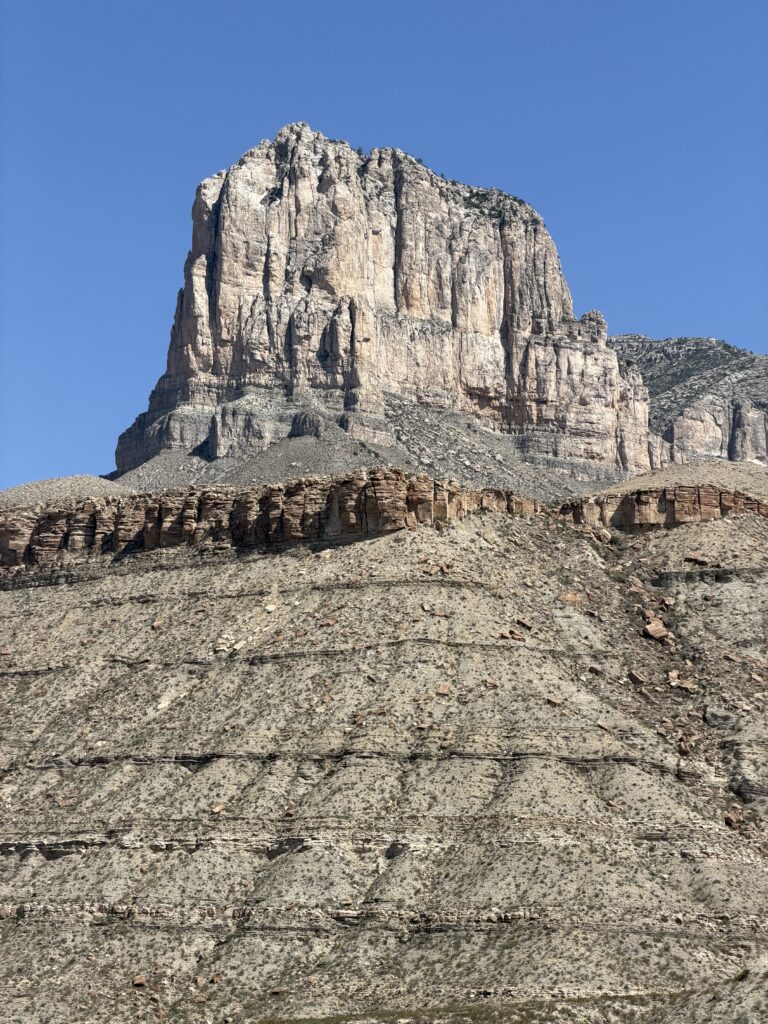
After leaving Carlsbad, we drove to the Guadeloupe Mountains National Park in west Texas. The 8,000 -foot mountain itself is the world’s most extensive Permian fossil reef and contains the four highest peaks in Texas. From the Visitor’s Center to the mountain, three distinct landscape layers lay before you, the desert floor, the alpine forests, and the rocky terrain of El Capitan with its sheer limestone rock wall rising 3,000 feet from the Permian shelf reef.
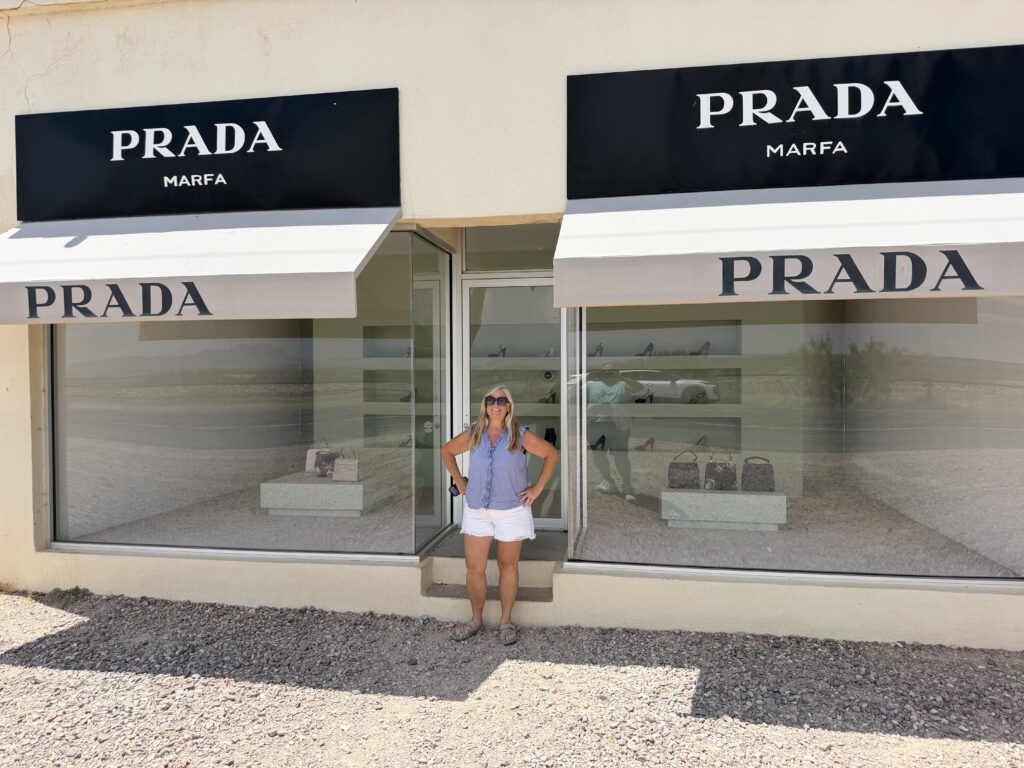
We continued south on US 62/180 and eagerly arrived at the Marfa Prada art installation in Valentine, TX. The Marfa Prada art piece was erected twenty years ago and has become somewhat of an iconic roadside attraction. It was quirky and cute, with a dozen tiny little right sided Prada footwear and purses.
We didn’t get a chance to see the Marfa Lights, another attraction that only appears at night. Glowing orbs appear on the horizon, and have been seen since the late 1880’s. They have been studied and documented but remain an unexplained phenomenon.
The only other cool attraction in Marfa is the Chinati Foundation Museum founded by the renowned, deceased Minimalist artist, Donald Judd. The staff were friendly, the artwork strange. I generally appreciate most works of art, but cement squares and rectangles the size of small rooms placed at odd angles outside in the desert landscape is not my idea of transformative expression. But, to each his own.
The awesome experience we did have there was that Shia LaBeouf, the actor, and his new girlfriend were also there walking around the place. No, I didn’t rush over and say hi, I left him alone. Besides, I understand he has a temper, so…
Part of traveling an having cool experiences is sometimes just being in the moment, not rushing to the next place, but truly being open for something new or different, and expecting the unexpected.